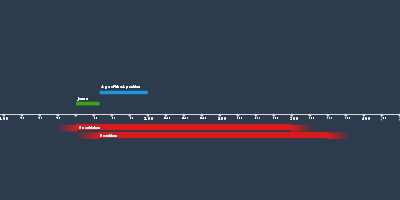
German Romanticism - The Völkisch movement - Nazism (mar 1, 1899 – nov 1, 1945)
Description:
German Romanticism (German: Deutsche Romantik) was the dominant intellectual movement of German-speaking countries in the late 18th and early 19th centuries, influencing philosophy, aesthetics, literature and criticism. Compared to English Romanticism, the German variety developed relatively early, and, in the opening years, coincided with Weimar Classicism (1772–1805). In contrast to the seriousness of English Romanticism, the German variety of Romanticism notably valued wit, humour, and beauty.--
The Völkisch movement emerged in the late 19th century, drawing inspiration from German Romanticism and the history of the Holy Roman Empire, and what many saw as its harmonious hierarchical order.[1] The delayed unification of the German-speaking peoples under a single German Reich in the 19th century is cited as conducive to the emergence of the Völkisch movement.[18]
Despite the previous lower-class connotation associated to the word Volk, the Völkisch movement saw the term with a noble overtone suggesting a German ascendancy over other peoples.[4] Thinkers led by Arthur de Gobineau (1816–1882), Georges Vacher de Lapouge (1854–1936), Houston Stewart Chamberlain (1855–1927), Ludwig Woltmann (1871–1907) and Alexis Carrel (1873–1944) were inspired by Charles Darwin's theory of evolution in advocating a "race struggle" and a hygienist vision of the world. They had conceptualized a racialist and hierarchical definition of the peoples of the world where Aryans (or Germans) had to be at the summit of the white race. The purity of the bio-mystical and primordial nation theorized by the Völkisch thinkers then began to be seen as having been corrupted by foreign elements, Jewish in particular.
Added to timeline:
Date:
mar 1, 1899
nov 1, 1945
~ 46 years