dec 5, 2019 - Significance of Events (Top 3)
Description:
Criteria for Historical Significance:Quantity and Profundity - How many people’s lives were affected and how deeply were they affected?
Durability - How long were people’s lives affected?
Relevance - How important and impactful is the event to our present lives?
Current Economic Crisis
The current economic crisis is chosen as one of the top 3 events of historical significance because of the combination of mass increases of unemployment and its large relevance to our present lives. To explain, during the peak of the recession, the US unemployment rate hit 10%, while losing over 7.5 million jobs. Moreover, American families lost approximately $16 trillion of net worth from the plummeting stock market. Not only that, the IMF (International Monetary Fund) concluded that the overall effect of the Great Recession was the worst since the Great Depression in the 1930s, one of those effects being that it helped push world unemployment above 200 million people for the first time. With this in mind, this ongoing event is very important as mass unemployment is detrimental especially when taking account that the global population growth remains very high, while fewer jobs are being created than jobs are being replaced by automation. Evidently, this event has a deep present impact that affects hundreds of millions of livelihoods.
Blair’s Third Way
Blair’s Third Way is chosen as one of our top three most historically significant events according to the criteria we chose – it displays profundity, durability, and relevance. The Third Way is quite similar to Canada’s current mixed economy, as well as the New Democrats of the United States. It showed a shift towards modern liberalism in a balance between Monetarism and Keynesian economics, which is relevant to many developed countries today that are evolving to represent this balance. Prominently associated with Tony Blair in the United Kingdom, this economic ideology has spread to many other countries, thus influencing hundreds of millions of people by allowing economic freedom while preventing drastic income disparity through levels of government intervention.
Great Depression
The Great Depression was also chosen as one of the most historically significant events, as it affected the vast majority of the United States (and even much of the international community), lasted for ten years, and was a key event in that influenced America’s future government intervention policies in the economy. At its worst, the Great Depression had over 15 million Americans unemployed, over half of all national banks had failed, and had had detrimental effects on countries dependent on the United States. Specifically, in comparison to America’s 25% unemployment rate, the unemployment rate in Germany also stood at 25%, highlighting the recession global impact. In addition, America’s gross domestic product (GDP) drastically declined from $103.6 billion in 1929 to $66 billion in 1934. In addition, the Great Depression led to relief and reform measures by President Franklin D. Roosevelt, who developed a government interventionist policy in order to help soften the consequences of the recession – today, the government has introduced taxes, subsidies, and regulation, resulting in embracing the ideologies of modern liberalism.
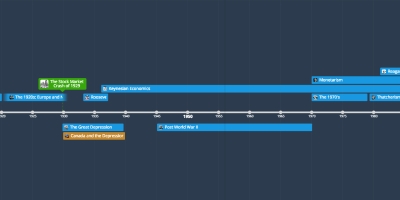
Added to timeline:
Date:
dec 5, 2019
Now
~ 6 years and 7 months ago