jan 1, 1000000000 BC - Events before 1.000.000.000 BC
Description:
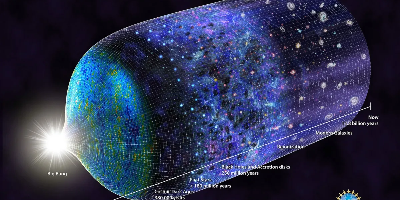
13.799.000.000 BC: Big Bang, the Planck Epoch begins.10^-43 s ABB: The Grand Unification Epoch begins, Gravity separates and begins operating on the Universe.
10^-36 s ABB: The Electroweak Epoch begins, the Strong Nuclear Force becomes distinct from the Electroweak Force.
10^-33 s ABB: Space is subjected to a superfast inflation, influenced by a repulsive energy field, expanding from the size of an atom to that of a grapefruit.
10^-32 s ABB: The cosmic inflation ends, quark-gluon plasma is formed.
10^-12 s ABB: The Quark Epoch begins, the Electromagnetic and Weak Nuclear forces become distinct.
10^-11 a ABB: Baryogenesis may have taken place with matter gaining the upper hand over anti-matter.
10^-6 s ABB: The Hadron Epoch begins, a quark-hadron transition takes place in which quarks bind to form hadrons.
1 s ABB: The Lepton Epoch begins, the hadrons and antihadrons annihilate each other, leaving behind leptons and antileptons.
10 s ABB: The Photon Epoch begins, the Universe is dominated by photons of radiation.
3 min ABB: Primordial Nucleosynthesis, protons and neutrons form light atomic nuclei.
20 min ABB: Nuclear fusion ceases, free electrons begin scattering light.
70.000 yrs ABB: Matter domination in the Universe, onset of gravitational collapse as the Jeans Length begins to fall.
370.000 yrs ABB: The cosmic Dark Ages begin, electrons combine with nuclei to form atoms.
13.790.000.000 BC: Density waves begin imprinting characteristic polarization signals.
13.700.000.000 BC: Ordinary matter particles fall into the structures created by dark matter. Smaller and larger non-linear structures begin to take shape.
13.600.000.000 BC: First stars begin to shine.
13.500.000.000 BC: First large-scale astronomical objects, protogalaxies and quasars may have begun forming.
13.200.000.000 BC: End of the Dark Ages as visible light begins dominating throughout.
13.100.000.000 BC: Galaxies form, smaller galaxies begin merging to form larger ones.
13.080.000.000 BC: Formation of globular clusters in Milky Way's galactic halo.
12.800.000.000 BC: The first galaxy clusters and galaxy superclusters appear.
9.800.000.000 BC: The Andromeda galaxy begins a collision course with the Milky Way.
8.800.000.000 BC: Planetary nebula appear in which rocky substances are solidified.
8.000.000.000 BC: Dark energy begins dominating the Universe. After beging slowed for billions of years by gravity, abundant dark energy hold and the cosmic expansion begins to speed up.
7.800.000.000 BC: The great walls, sheets and filaments consisting of galaxy clusters and superclusters and voids crystallize.
4.570.000.000 BC: Formation of the Solar System, planetary nebula begins accretion of planets.
4.540.000.000 BC: Formation of the Earth.
4.530.000.000 BC: Formation of the Moon, following a giant impact by the hypothetical planetoid Thea.
4.500.000.000 BC: Formation of the Oort Cloud and Kuiper Belt from which a stream of comets begins passing through the Solar System. Sun enters main sequence, a solar wind sweeps the Earth-Moon system clear of debris.
4.450.000.000 BC: The pluvial period starts, in which the Earth's crust cools enough to let oceans form.
4.400.000.000 BC: A secondary atmosphere forms, produced by the Earth's crust outgassing, reinforced by water and possibly organic molecules.
4.250.000.000 BC: Earliest evidence of life, based on unusually high amounts of light isotopes of carbon.
4.100.000.000 BC: Late Heavy Bombardment batters the inner Solar System, conducive to abiogenesis and life's early diversification. Oldest known rocks with remains of biotic life form.
4.000.000.000 BC: First appearance of plate tectonic activity in the Earth's crust as plate structures may have begun appearing.
3.800.000.000 BC: First complete continental masses or cratons, formed of granite blocks, appear on Earth.
3.600.000.000 BC: Oldest cratons on Earth begin growing as a result of crustal disturbances along continents coalescing into Vaalbara.
3.500.000.000 BC: Split betweem bacteria and archaea occurs as "tree of life" begins branching out.
3.480.000.000 BC: First appearance of stromatolitic organisms that grow at interfaces between different types of material.
3.100.000.000 BC: Fig Tree Formation, second round of fossilizations including Archaeosphaeroides barbertonensis and Eobacterium.
3.000.000.000 BC: Photosynthesizing cyanobacteria evolve. They use water as a reducing agent, thereby producing oxygen as a waste product. Microbial mats become successful forming the first reef building communities on Earth in shallow warm tidal pool zones.
2.800.000.000 BC: Breakup of the Vaalbara and supercontinent Ur as it becomes a part of the major supercontinent Kenorland.
2.700.000.000 BC: Major komatiite eruption, possibly global - possible mantle overturn event.
2.600.000.000 BC: Saturation of oxygen in ocean sediments is reached as oxygen now begins to dramatically appear in Earth's atmosphere.
2.500.000.000 BC: Great Oxygenation Event led by cyanobacteria's oxygenic photosynthesis. Various forms of anoxic bacteria become extinct.
2.400.000.000 BC: Huronian glaciation starts, probably from oxidation of earlier methane greenhouse gas produced by burial of organic sediments of photosynthesizers.
2.100.000.000 BC: Earliest multicellular organisms collectively referred to as the "Gabonionta".
2.050.000.000 BC: Significant orogeny in most continents.
1.850.000.000 BC: First Eukaryotes appear. Bacterial viruses emerge before, or soon after, the divergence of the prokaryotic and eukaryotic lineages.
1.800.000.000 BC: Oldest ergs develop on several cratons.
1.600.000.000 BC: Platform covers expand.
1.500.000.000 BC: First structurally complex eukaryotes.
1.400.000.000 BC: Major increase in Stromatolite diversity with widespread blue-green algae colonies and reefs dominating tidal zones of oceans and seas.
1.300.000.000 BC: Widespread anorogenic magmatic activity, forming anorthosite-mangerite-charnockite-granite suites.
1.200.000.000 BC: Meiosis and sexual reproduction are present in single-celled eukaryotes, and possibly in the common ancestor of all eukaryotes. Supercontinent of Rodinia completed.
1.100.000.000 BC: First dinoflagellate evolve.
1.000.000.000 BC: Decline in stromatolite reef populations begins. Possible divergence between animal and plant kingdoms begins.
Added to timeline:
Date:
jan 1, 1000000000 BC
Now
~ 5883516 years ago